Ace Deck Builders

Deck Building for Small Austin Businesses

Commercial deck building at Ace covers small-scale projects for Austin businesses: restaurant and cafe patio decks, small office and retail decks, and ADA-compliant ramps and platforms. The structures are residential in scale, built to the commercial code requirements they trigger.

There’s a gap in the Austin market. Commercial general contractors don’t want a 400-square-foot cafe patio; the project is too small for their overhead. Residential deck companies will take the job, then discover at plan review that a deck open to the public carries requirements a backyard deck doesn’t. We work in that gap deliberately, with a scope we’re upfront about: if your project is a small structure for a small business, this page is for you. If it’s a multi-tenant development or a large hospitality build, we’ll say so on the first call and point you toward a commercial GC, because pretending otherwise wastes your schedule.

Call Now

(512) 566-7519

Request Free Estimate
  • This field is for validation purposes and should be left unchanged.

Restaurant and cafe patio decks

Outdoor seating areas built for public occupancy loads, with commercial-grade railing systems and slip-resistant surfaces. Composite is usually the right surface for food-service settings because it cleans easily and skips the refinishing cycle; read about our composite deck installation options for the materials side.

Small office and retail decks

Entry decks, break-area platforms, and small elevated decks for offices and shops. Structurally these are residential builds; the differences live in occupancy load, egress, and railing code, and the spec accounts for each.

ADA-compliant ramps and platforms

Access ramps, landings, and transition platforms built to ADA and Texas Accessibility Standards: slope ratios, landing dimensions, handrail heights and extensions, and surface requirements. For existing structures, the project often starts with an assessment of what’s there; that’s how our deck inspection process works on commercial structures too.

What we don't take on

Multi-tenant developments, large hospitality venues, rooftop amenity decks on commercial buildings, and anything requiring structural steel or an engineer of record beyond a soils review. Those projects belong with a commercial general contractor, and we’ll tell you that in the first conversation rather than after a deposit

What Changes When the Public Walks on It

  • Occupancy loads. Public-use decks are designed to higher live loads than backyard decks. That changes joist sizing, beam spans, and footing dimensions, and it’s the first thing the spec addresses.
  • Accessibility. Public accommodations trigger ADA and Texas Accessibility Standards requirements that residential work never sees: ramp slopes, landing sizes, handrail geometry, and surface transitions. We build to those standards and document compliance in the spec.
  • Railing code. Commercial guardrail requirements differ from residential in height and load resistance. Take a look at how we handle deck railing installation with the commercial standards applied.
  • Permitting. Commercial permits involve plan review steps residential permits skip. Our trusted third-party permit partners handle the submissions, and the review timeline gets built into the project schedule from the start rather than discovered midway.
  • Insurance documentation. We’re fully insured and provide certificates of insurance to landlords and property managers on request, which small-business tenants frequently need before work can start.
  • Working hours. We schedule the disruptive phases around your business hours where the work allows it, and we’re straight with you about which phases can’t move. Demolition is loud no matter when it happens.
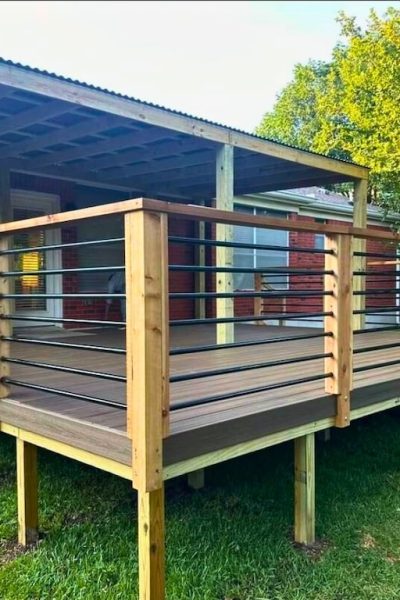
Wooden deck with metal and wood railing attached to a brick house. The deck is elevated with a corrugated metal roof and set against a grassy yard and trees.

How a Small-Commercial Project Runs

The sequence matches our residential builds with two additions. The site visit covers occupancy and accessibility requirements along with the usual grade and soil assessment. And the written spec documents code compliance explicitly, because your landlord, your insurer, and the plan reviewer will all want to see it. From there: permits through our partners, the build to spec, and a final walkthrough with the one-year workmanship warranty starting at completion. The full sequence is the same one described in what’s included in a new deck installation, with the commercial layers added.

Where We Take Small-Commercial Work

We take small-commercial projects across Austin, Round Rock, Cedar Park, Leander, Georgetown, and Pflugerville, plus Lakeway, Bee Cave, and West Lake Hills. If you run a business in one of these areas and the project sounds like the scope above, request a deck estimate online or call (512) 566-7519, and the first conversation will tell you honestly whether we’re the right size of builder for it.

Call Now

(512) 566-7519

Frequently Asked Questions

Small-scale projects where the structure is residential in size: restaurant and cafe patios, small office and retail decks, and ADA ramps and platforms. As a practical guide, if the project is under roughly a thousand square feet and doesn’t require structural steel or an engineer of record beyond a soils review, it’s likely in our scope. Larger or more complex projects belong with a commercial general contractor, and we’ll say so in the first conversation.

Yes. Ramps, landings, and transition platforms built to ADA and Texas Accessibility Standards, covering slope ratios, landing dimensions, handrail heights and extensions, and surface requirements. Compliance is documented in the written spec, which matters because accessibility is the part of small-commercial work most often flagged at plan review. For additions to existing structures, the project starts with an assessment of what’s already there.

Four main ways: higher design loads for public occupancy, accessibility requirements under ADA and Texas standards, stricter guardrail height and load rules, and a commercial permit process with plan review steps residential permits skip. Structurally the builds use the same materials and methods; the difference is the requirements layered on top, and the spec addresses each one explicitly.

Yes. We’re fully insured and provide certificates of insurance on request, naming the landlord or property manager as certificate holder where required. Texas doesn’t license deck contractors, so insurance documentation is the credential that matters here, and most commercial leases require it before any contractor starts work on the premises. Ask for it early so the paperwork doesn’t hold up the schedule.

Where the work allows it, yes. Layout, framing, and finish phases can often run early mornings or around your slow periods. We’re straight about the phases that can’t move: demolition is loud and dusty whenever it happens, and concrete pours follow cure schedules, not store hours. The project schedule we give you marks which phases are flexible and which aren’t, so you can plan staffing around the noisy days.

Almost always, and the process involves plan review steps residential permits skip, especially when accessibility requirements apply. Our trusted third-party permit partners handle the submissions with the City of Austin and surrounding municipalities, and the review timeline gets built into the project schedule upfront. Skipping the permit on a public-use structure is a risk no business should take; it surfaces at inspection, at sale, or after an incident.

Composite is usually the right call for food service: it cleans easily, handles spills without staining the way wood does, and skips the refinishing cycle that would otherwise close your patio every couple of years. Slip resistance matters more than in residential settings, and railing systems need to meet commercial load requirements. Wood remains an option where the look matters and the maintenance schedule is realistic for the business.

Yes. Lakeway, Bee Cave, and West Lake Hills are part of our standard coverage, and small-business projects there follow the same scope rules as Austin proper. Each of those municipalities runs its own permit process, which our permit partners work in regularly. Hill Country site conditions apply to commercial lots the same as residential ones, so the soil and grade assessment is part of every site visit.